

There are no doubt countless services and memberships in the world of travel. Airport ‘premium’ memberships, special security privileges, lounge memberships – you name it. More often than not I find these overpriced or of marginal value. But there is a suite of US federal programs that is both very affordable and saves you a lot of time and hassle. I’m talking about TSA PreCheck and Global Entry.
- What are TSA PreCheck and Global Entry, and what is the difference between them?
- Who is eligible?
- What are the TSA PreCheck and Global Entry application fees?
- How do you apply for these programs?
- It may be FREE for you with your credit card! These are the credit cards that reimburse the application fee
- What happens after approval? How do you use it?
- Which one should you apply for?
- Summary
What are TSA PreCheck and Global Entry, and what is the difference between them?
The federal government of the USA has a number of travel programs that make security and immigration checks speedier for those enrolled in these members-only services. Although there are a few of them, here I will focus on TSA PreCheck and Global Entry only, as they are by far the most useful for the wider public. That is, the other services (such as SENTRY), are really only useful for those specifically needing to cross the borders of the US and Canada or the US and Mexico. Therefor, it’s only useful for a particular traveler, whereas TSA PreCheck and Global Entry have very wide appeal. So what are they?
What is TSA PreCheck?
TSA PreCheck is focused on speeding up the security check at US airports and select foreign airports where you can board flights to the USA. Enrolling in this program will grant you access to a special line at the security checkpoint at the airport. In this line you won’t need to show your boarding pass (ID will be enough, but ensure it is REAL ID compliant), you won’t need to take off your shoes and may not need to remove electronics from your bag. You will still need to remove contents from your pockets, as well as your jacket. However, these small conveniences, plus the general lack of people that enroll in TSA PreCheck, means shorter lines overall and faster processing speed through the security checkpoint. Though I will add, the number of people enrolled in TSA PreCheck has been on the rise since the pandemic.
Note that not every single airport or airline offers TSA PreCheck! Typically, small airports with few travelers will not offer TSA PreCheck given the low volume of passengers. But note that some airlines do not have a partnership with TSA that allows for TSA PreCheck either. However, every so often new airlines partner with TSA to offer this for their passengers. You can search for airports and airlines that currently offer/partner with TSA PreCheck. as you will see, major airlines flying to the US typically do partner with TSA to offer TSA PreCheck for their passengers.
What is Global Entry?

While TSA PreCheck is all about getting through the security checkpoint fast, Gobal Entry instead is about getting through immigration ASAP when returning to the US. This applies both to immigration control at US airport, as well as select foreign airports that have a US pre-clearance facility, such as most international airports in Canada with flights to the US, and select others across the world.
Recently, Global Entry procedures have been upgraded with a new facial recognition kiosk: you take position before the kiosk and without any input it will snap a picture, match your face to Global Entry database, and process your entry. You then pass by an officer who will call your name to confirm it’s you, and wave you through. It’s an incredibly simple and fast process that makes re-entry into the US essentially painless.
Note that Global Entry is not just useful for re-entry at airports: it also works at seaports and land border crossings. However, for these entry points into the US you need to present a membership card that you receive after approval. For entry through airports, this card is not necessary.
Note that Global Entry is not available at every single international airport in the US, so you may want to check whether your preferred international airport offers it. You can view this here. However, it’s essentially guaranteed that major US airports, as well as select foreign airports with many flights to the US, will offer this service. For example, every major Canadian airport has a US pre-clearance facility, and all of these offer Global Entry as well.
What is the TSA’s Touchless ID Program?
This is an evolution of TSA PreCheck that aims to remove the need to present an ID document entirely. The nice thing about is that you get your own lane at the checkpoint, and since this is not a very popular program yet, with relatively few people enrolled, the line is currently still quite short. The caveat is that it’s only available at certain airports, and only Alaska, Delta, United, American and Southwest are currently participating. I have published a dedicated post about it with full instructions on how to enroll.
Who is eligible?
Eligibility for TSA PreCheck and Global Entry is more or less the same, with some exceptions. This may sounds strange, but Global Entry is actually open to a larger contingent of people than TSA PreCheck is, because Global Entry is open to citizens of a select set of countries besides the USA. While only US citizens or lawful permanent residents can apply for TSA Precheck, citizens of the following countries can apply for Global Entry:
- Argentina
- Brazil
- Bahrain
- Colombia
- Croatia
- Dominican Republic
- India
- Germany
- Mexico
- The Netherlands
- Panama
- Singapore
- South Korea
- Switzerland
- Taiwan
- United Kingdom
I had no idea myself about this until about half a year ago, when my mother’s neighbor, a Dutch citizen who travels to Boston a lot from his home in the Netherlands, mentioned that he has it. So, as it turns out, I could have applied for Global Entry 10 years ago and save myself the wait in the US visa line…
What are the TSA PreCheck and Global Entry application fees?
The prices for these programs have recently gone up, but I’d argue it’s still very much worth it. TSA PreCheck by itself will set you back $77.95, $78 or $85. Global entry will cost $120, but also includes TSA PreCheck for that same price. If you only sign up for TSA PreCheck and want Global Entry later, you will need to pay the extra $120.
How do you apply for these programs?
To apply for TSA PreCheck, you would pre-register inline through Clear ($77.95), TELOS ($85) and IDEMIA ($78). You would then visit an enrollment location, which can be found through the websites of these providers, to complete the application. You would then hear back with the results within 5-60 days, though for most that timeline should be closer to the lower end of that waiting period.
Global Entry enrollment is done solely through the dedicated website of the Trusted Traveler Program (TTP), though the procedure is similar. After applying online and paying the non-refundable fee, you would wait for conditional approval. This will be granted following a background check which usually takes a few months to clear, assuming one wasn’t done recently (for example when applying for a green card). This would make you eligible to book an appointment at an enrollment center for an interview, which will be at a nearby airport in the majority of cases. At the end of the interview you can expect to be approved and immediately receive Global Entry membership, but note that there can be a substantial ‘line’ for an appointment: at busy places such as New York’s JFK, the wait can be up to 3 months, so if you’d like to get Global Entry for a specific trip, start the process well in advance!
In both cases, once final approval has been granted, you will be given your ‘Known Traveler Number’, or KTN. Generally this number is the same as your application number.
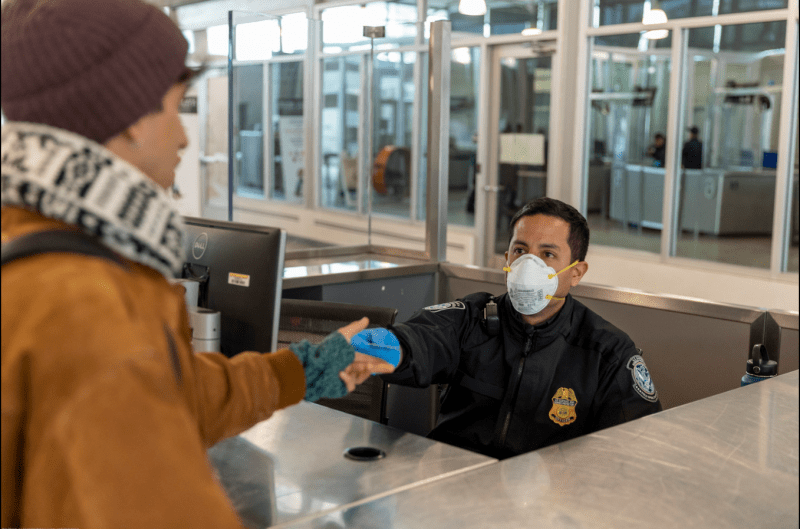
Note that you can do the interview ‘upon arrival‘ as well. This would be especially useful for those applicants who are foreign nationals, but also those that want to use Global Entry while only being conditionally approved. Click the link above to see full instructions, but essentially there should be immigration officers that can do the interview at border control. So, you should not need to go through immigration first, and then do the interview. it should be possible to do passport control and the interview at the same time.
It may be FREE for you with your credit card! These are the credit cards that reimburse the application fee
Quite a lot of credit cards will provide a statement credit once every four years if you use your card to pay for the application fee. The TSA PreCheck website has compiled a fantastic list with all credit cards that offer TSA PreCheck, though I have removed some entries that are of little appeal to the general public, keeping those that you may be more interested in. Still, feel free to have a look at the original list. The more interesting cards, which also offer Global Entry fee reimbursement, are the following:
- Aeroplan® Credit Card
- American Airlines Credit Union Visa® Signature credit
- Bank of America® Premium Rewards® credit card
- Capital One® Spark® Miles Card
- Capital One® Venture® Card
- Capital One® Venture X® Business Card
- Capital One® Venture X® Card
- Certain American Express® Credit Cards
- Chase Sapphire Reserve® Credit Card
- Choice Privileges® Select Mastercard®
- Citi® / AAdvantage® Executive World EliteTM MasterCard®
- Citi Prestige® Card
- Delta SkyMiles® Platinum American Express Card
- Delta SkyMiles® Reserve American Express Card
- IHG One Rewards Premier Credit Card
- IHG One Rewards Premier Business Credit Card
- Marriott Bonvoy Brilliant™ American Express® Card
- MasterCard® Black Card™
- MasterCard® Gold Card™
- One Key+™ Card
- Southwest Rapid Rewards® Performance Business Credit Card
- United ClubSM Infinite Card
- UnitedSM Explorer Card
- United QuestSM Card
- U.S. Bank Altitude® Connect Visa Signature® Card
- U.S. Bank Altitude® Reserve Visa Infinite® Card
- U.S. Bank FlexPerks® Gold American Express® Card
As you can see, that’s a substantial list. The more interesting ones in this list are undoubtedly the Capital One Venture (X), Chase Sapphire Reserve and Citi Prestige card, since they are all-around the most useful. However, the Aeroplan credit card, United Explorer card and IHG One Choice Premier card are also good choices. Air Canada’s Aeroplan program is all-around a useful program, the United Explorer card comes with nice perks for United flyers, and the IHG Premier card is low-cost and perk-packed card that I personally will apply for soon.
How do you get the credit for your application fee? it should be entirely automatic. Like with other automatic credits, the bank scans your statements for certain codes and descriptions. So, the charge for TSA PreCheck or Global Entry should trigger the credit automatically assuming that you didn’t receive the credit yet within a four-year period.
What happens after approval? How do you use it?
Once you’ve been approved for either TSA PreCheck, Global Entry, or both, you will have received your Known Trafveler Number (KTN). Generally this is your application number. To now ensure that you can use the benefits of these programs, you must add the KTN to your airline booking before online checkin or heading to the airport. That is to say, if your KTN is not part of your booking, you will not be able to use TSA PreCheck. You can still, however, use Global Entry, but obviously this is only useful when entering the US and passing immigration.
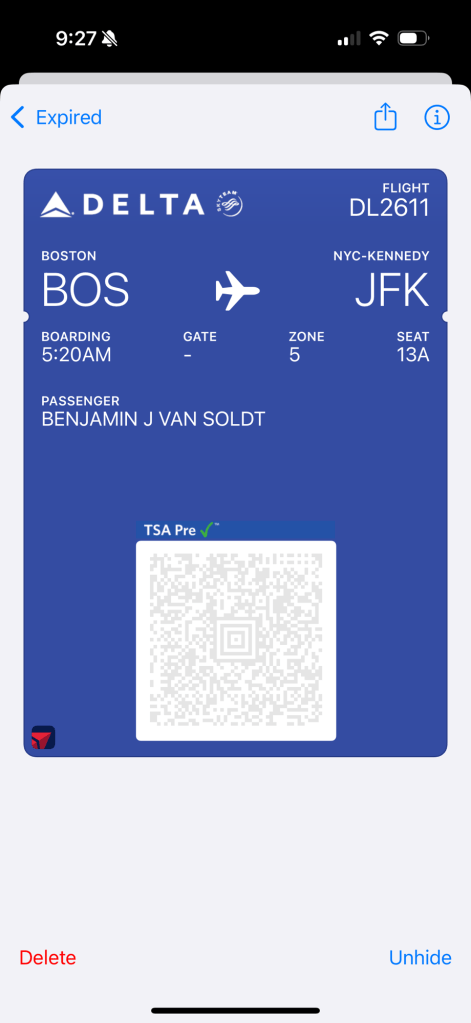
How do you know that your KTN was successfully added and you can use TSA PreCheck? It should be clearly marked on your boarding pass, regardless of whether it’s a digital boarding pass on your phone or a boarding pass printed at the airport. On the below (expired) digital ticket for my flight from Boston to New York-JFK, you see a little ‘TSA PreCheck’ logo at the upper left of the QR code, as a sign that the KTN was added to the booking and I can use the TSA PreCheck lane, while on my paper boarding pass for my flight to Tokyo it says ‘TSA PRE’ right above the big letter ‘C’. If this logo/text does not appear, you will not be able to use the TSA PreCheck lane. You need to show the boarding pass and if the officer doesn’t see the logo, they won’t let you through.

Which one should you apply for?
Let’s get this out of the way first: if you travel by plane with any frequency, TSA PreCheck can be a huge time and frustration saver by cutting down the amount of time you spend in line at the security checkpoint, and removing the need to take off shoes etc. It simply makes for a smoother ride through secruity.
However, whether you should apply for the Global Entry/TSA PreCheck combo really hinges on whether you travel internationally. Personally I believe that if even you travel internationally just once a year, Global Entry is already worth it for the time savings and simplification of the re-entry process. Besides, when you apply for Global Entry you also get TSA PreCheck, so you can save money by applying for Global Entry straight away. However, if you never leave the USA, then truly there is no point in getting Global Entry and you might as well get TSA PreCheck only. I will add that since I’ve been a Global Entry member, I have more or less breathed through immigration: a process that used to take over an hour at New York-JFK has been reduced to a 5 to 10-minute process. If you ask me, such time and frustration saver is absolutely worth the investment. And frankly, I find that $120 for four years is really not much of an investment anyhow as it comes down to $30 per year. To put that into perspective, in New York an average lunch is $30 this year. Elsewhere, $30 may be two lunches or a nice dinner. To each their own, but to me that price is worth the time and frustration saving of Global entry and TSA PreCheck.
Summary
In this post I have described TSA PreCheck and Global Entry, and hopefully convinced you of the use and cost effectiveness of these programs. I believe they are a must for any semi-frequent air traveler, as it can save some substantial frustration and time at security and immigration upon re-entry into the US.
If you are convinced and would like to apply, I certainly recommend applying for Global Entry straightaway, since it includes TSA PreCheck for only $40-50 more, depending on how you apply for TSA PreCheck. it can be a rather drawn-out process, but it’s absolutely worth it in my mind for the $120. Besides, with the right credit card an automatic statement credit will pay for the fee outright once every four years (basically once every application cycle), and so this program may actually be free for you anyway! Why not use it, then?


 Points to Seats
Leave a comment