

I have written before about Alaska Airlines loyalty program: MileagePlan. When Alaska acquired Hawaiian Airlines, we already knew a few things would change. For one, Alaska Airlines announced they would make Seattle into their global gateway, they also announced a new loyalty program that would replace Alaska’s and Hawaiian’s separate programs (and the two currencies have been combinable for a little while now), and we also learned that there’d be an entirely new premium credit card that would exist in addition to the existing Alaska MileagePlan credit card.
Well, the new program is here, and its called Atmos Rewards, and the miles you earn are now referred to as Atmos Rewards points. What has changed? What has stayed the same? And what’s this new credit card all about? The credit card I’ll cover in a separate post, but let’s get on with the changes in the loyalty program.
- Release timeline
- New branding, but otherwise mostly the same program
- Tier names ditch MVP, now adhere to a more standard naming scheme
- Qualification requirements increase for the higher tiers
- Higher tiers have enhanced perks, justifying the higher requirements
- An innovative new feature coming 2026: choose how you earn points
- Another fantastic feature: free point sharing with up to 10 people for Summit card holders (see below)
- Atmos Rewards retains the fantastic set of partner airlines for flight redemptions
- Award flights count towards status qualification
- And what about the credit cards?
- Summary
Release timeline
Right now, Alaska MileaghePlan has been replaced by Atmos Rewards. However, the Alaska/Hawaiian group hasn’t totally transferred to this new program quite yet. Hawaiian will follow suit only in October, at which point the Hawaiian Miles program will also cease to exist and merge into the combined Atmos program. It will then be only in January 2026 that the final bits of the program will transition, primarily because that’s when the status qualification year ends. That means that to qualify for status in 2026, the MileagePlan guidelines will still be in effect, to change a sof January 29026 for qualification for the 2027 status year.
New branding, but otherwise mostly the same program
The truth is that from Alaska MileagePlan to Atmos Rewards there aren’t all that many differences. In fact, the program is more or less the same, with earlier announced changes remaining intact. But does add a few neat tricks as of January 2026. So what are the primary features of the program?
Tier names ditch MVP, now adhere to a more standard naming scheme
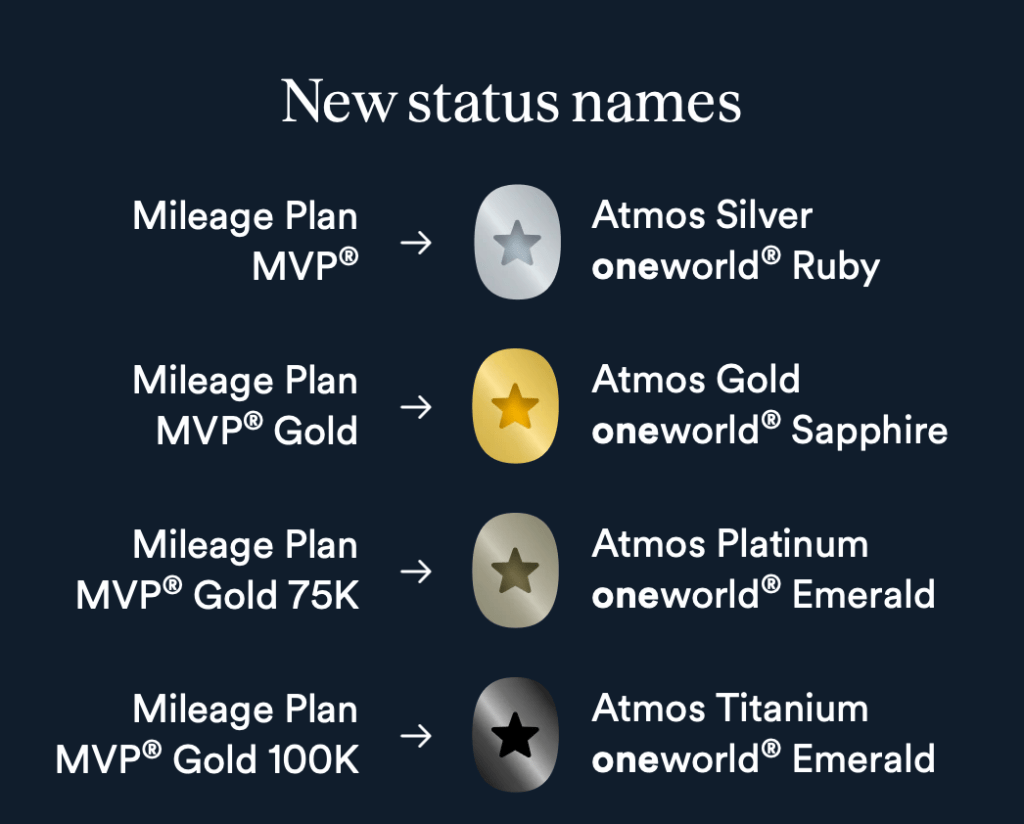
Alaska Airlines’ MileagePlan tiers all had the name MVP, plus a further tier identifier. These never made much sense to me personally, and so I’m glad that Alaska has saw fit to ditch these names. So, MVP will become Silver, MVP Gold will become Gold, MVP Gold 75K becomes Platinum, and MVP Gold 100K becomes Titanium, as you can see to the right. The mapping onto oneworld’s frequent flyer scheme then gives you oneworld Ruby for Silver, Sapphire for Gold, and Emerald for Platinum or Titanium. Overall, a sensible scheme.
Qualification requirements increase for the higher tiers
Alaska Airlines MileagePlan has a tiered system where you could unlock certain perks before, in-between and after hitting the main status qualification tiers. The first of these was at 10K, and is a fairly small perks, such as a small amount of free miles. Then the first status qualification tier is at 20K, and grants MVP status, see below:
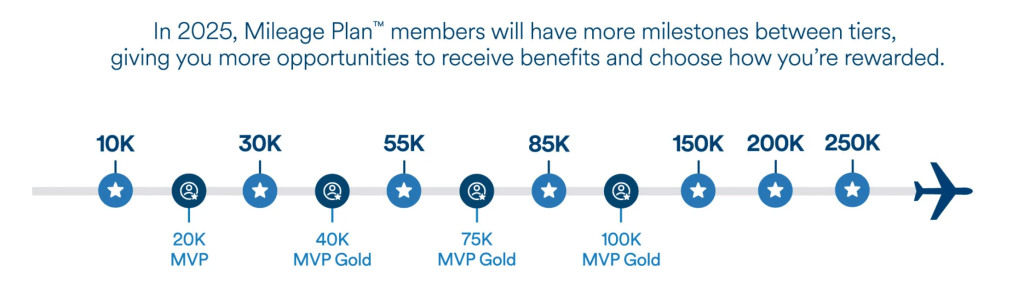
For 2025 only, that scheme stays unchanged for Atmos Rewards, as you can see from the below scheme. The main status qualification tiers remain unchanged, and the in-between tiers that unlock certain perks also have the same requirements:

Unfortunately, there will be some changes to that scheme. In 2026, Platinum will require an additional 5000 status points (a round-trip flight from NYC to SF) for a total of 80K points, while Titanium will require a whopping 135K points, so 35.000 points more:

This is of course disappointing, but it is not entirely unjustified, as I’ll discuss in a moment. Plus, it seems Alaska is aware that this heightened tier may come off badly, so the company will provide a head-start to those who qualify for either Platinum or Titanium. Platinum holders will get a 5000-point head-start, which means that’s need ‘the usual’ 75K points to requalify, whereas Titanium holders will get 30K, meaning they will need to earn an additional 10K, on top of the usual 100K, to requalify. And, I take it, as of 2027 there will no longer be a head-start anymore.
Higher tiers have enhanced perks, justifying the higher requirements
One reason for the higher requirement, especially for the Titanium tier, seems to be that it comes with a big new bonus: Titanium holders will be able to get unlimited same-day upgrades into business class on global routes (meaning domestic and international). This is pretty much a first, at least in the US. Imagine going to the airport and scoring a complimentary upgrade on your flight from Seattle to Rome! That’d be nice…
Of course we will have to wait and see at what rate these upgrades actually clear, because it’s certainly difficult to get domestic first class upgrades clear at most US airlines. The perk will become fairly worthless if it never actually clears…
As an aside, another Titanium-specific perks seems to be a complimentary free meal (other status holders get a free drink or chocolate). Beyond that, it doesn’t seem Titanium holders get further special perks.

An innovative new feature coming 2026: choose how you earn points
Clearly the changes to the qualification tiers are a bit mixed, given the higher cost, but also interesting new perk it provides. However, as of 2026 there will be another change to the program that I think is very intriguing and I’d be quite excited about: you’ll be able to choose how you earn points. Currently, Alaska Airlines is one of the few remaining airlines that allows you to earn 1 mile per mile flown. This is of course how almost every airline let you earn back in the day, but now it’s mostly based on dollars spent, with increasingly higher status tiers getting more miles per dollar spent.
For 2025, Atmos Rewards doesn’t change how you earn your points: it will still be 1 point per mile flown. However, as of January 2026, you will be able to choose the scheme that works best for you:
- You can continue earning 1 point per mile flown.
- You can earn by spending, with at least 5 points per dollar spent, or 1 point per 20 points redeemed, if booking an award ticket.
- You can earn a flat 500 points per segment.
You’ll be able to change the earning scheme once per year, so it makes sense to consider your strategy. Fortunately, Alaska basically tells you what to do:

So, what’s strategy? You have to consider the trifecta of distance, spending and frequency:
- Do you fly long distances in economy, where the distance is long but the spend low? Select to earn based on distance flown.
- Do you fly premium cabins, where the tickets are more expensive? Your better bet may be to earn by spending.
- Do you fly short distances, such as between the Hawaiian Islands? You’ll want to go for the 500-point flat per-segment scheme.
An example with a transcontinental flight in the US: Say you fly NYC-LA, which is a ~2500-mile journey. If you earn per mile, that’d be 5000 points roundtrip. If you earn per dollar and spend $500 on a roundtrip economy ticket, that’d net you 2500 miles. And if per segment, you’d earn 1000 points. So, of course the per-distance would make more sense here.
Now, what if you buy a $1200 first class return ticket? Now, the earning based on spending will earn you 6000 points, and so the earning based on spending makes more sense (since distance doesn’t otherwise change).
Another fantastic feature: free point sharing with up to 10 people for Summit card holders (see below)
Quite a lot of airlines allow you to pool, or share points these days, but most airlines have restrictions on this in a way that makes Alaska’s implementation the most generous we have seen to date. Impressively, Alaska Airlines will allow you to share your points with up to 10 people if you have Alaska’s new premium credit card, the Atmos Rewards Summit card, seemingly without any kind of familial requirements, or other limits. This honestly sounds too good to be true, so let’s see how this will work in real-life…

Atmos Rewards retains the fantastic set of partner airlines for flight redemptions
One reason that Alaska Airlines MileagePlan was a useful program to invest in, was because Alaska is part of oneworld. Part of onworld are airlines such as Cathay Pacific, Japan Airlines, Qantas, British Airways, Qatar Airways and Oman Airways, among several others. These are all good airlines, many of them with lovely business (and first) class products, not to mention some of the lovely lounges these airlines operate for premium cabin passengers.
Atmos Rewards retains this partner network, continuing the possibility to redeem flights with these airlines for generally favorable rates, with low taxes and fees. That is, if you cna find availability, since that has become something of an issue as of late. In that sense, Alaska’s oneworld partner American Airlines is somewhat more favorable, specially with the recently released Citibank Strata credit cards that allow you to easily accumulate American AAdvantage points.
I should point out that this situaiton is not per se Alaska’s fault. If anything, it’s because Alaska’s partners simply release more award availability to their own members rather than through their partner airlines.

Award flights count towards status qualification
This is something that had been implemented since the last update to Alaska MileagePlan, and thankfully this wonderful feature remains: the ability to earn status qualifying points from award flights. This is powerful, since it means you can redeem your points for any flight through Alaska Airlines, on its own planes or with partners, and still get closer to status. Most airlines in the world will not credit you points for award flights, so this is a welcome feature that I’m glad to see remain in Atmos Rewards.
From Alaska’s perspective, this makes a lot of sense too, because it fosters people to spend their miles through Alaska for oneworld award tickets rather than through its partners, whether that’s American Airlines, Japan Airlines or Cathay Pacific – it generates loyalty. Like I mentioned above, though, the main problem with Alaska these days is that the aspirational, good-value awards are not easy to book.
And what about the credit cards?
I will dive into more detail in a separate post, but suffice is to say that the Alaska MileagePlan Visa card has now been rebranded into the Atmos Rewards Ascent card, and offers the same perks as its predecessor.
More exciting is the all-new Atmos Rewards Summit card, in partnership with Bank of America, which is Alaska’s new premium card. The annual fee clocks in at $395, but it also comes with perks that definitely will be useful for those that fly Alaska with some frequency, would like to qualify for status with Alaska, or frequently redeem through Atmos.
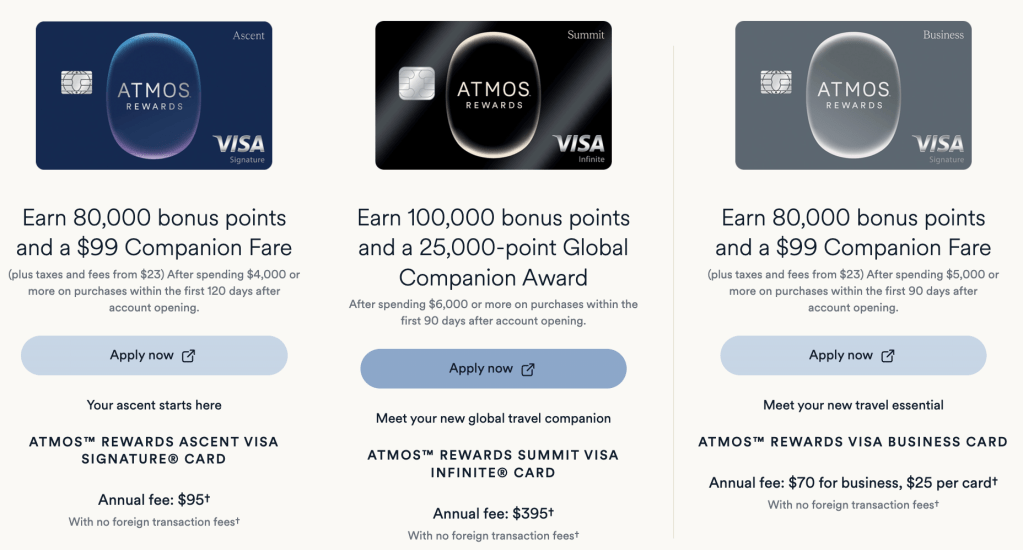
The Summit card’s big-ticket perks are:
- A 25.000 ‘companion ticket points’, meaning if you book reward tickets for 2 people, the second person gets 25.000 points of the award ticket. That’s probably good for a US transcontinental economy ticket. You cna get an additional 100.000 companion point award if you spend $60.000 on the card.
- 8 Alaska Airlines lounge passes, with 2 passes deposited into the primary card holder’s Atmos Rewards account every quarter.
- Earn unlimited 1 status point per $2 spent, allowing you to mroe quickly spend your way to status.
- Receive 10.000 status points on your card anniversary.
- $120 TSA PreCheck/Global Entry credit.
- 3x points on purchases in foreign currency, or in US Dollars processed outside the US.
- Free point sharing with up to 10 people
Summary
All in all, Atmos rewards is a rebranded MileagePlan, but with a few changes. On the not-so-bright side, Platinum and Titanum (previously MVP Gold 75K and 100K) will require more status points for re-qualification. But on the bright side, that comes with additional perks, such as same-day complimentary upgrades to business class on global route. Otherwise, Atmos will offer points sharing as of 2026 and the ability to pick by what scheme you earn points, both of which are useful and innovative features. Popular and useful feature that already existed and remain are the ability to earn qualifying points from award flights, and fantastic partner network that enables aspirational booking opportunities with oneworld airlines.


 Points to Seats
Leave a reply to Lounge Review: American Admirals Club at New York-JFK Terminal 8 – Points to Seats Cancel reply