

There are a lot of credit cards on the market. I frequently get asked what are my favorittre cards, and which ones I would recommend, so I thought I’d spent some time discussing this. In the past I have written about the different types of credit cards you can get, and how points rewards credit cards are my preferred type – this post puts some of that into practice byt showing you what cards I value most (of the ones I have), and why.
- The strategy behind my credit card portfolio
- My current favorite card: American Express Gold Card
- Favorite card for the perks: Citibank Strata Elite
- Favorite travel card: Chase Sapphire Preferred
- Favorite for miscelaneous purchases: Capital One Venture Rewards
- Favorite no-annual fee card: Chase Freedom Ultimate
- Summary
The strategy behind my credit card portfolio
I want to start out by briefly talking about my process for getting a new card, because indiscriminately amassing credit cards will not give you the best return on investment. Critically, you need to figure out the spend categories you spend the most on, and get credit cards that will give you the best return on them. It’s about ‘why, what and when’, in that order:
- Why: what do you need a new card for? What specific kind of spending will you put on it? For example, groceries or dining are categories many people spend a lot of money on.
- What: which card would be most suitable?
- When: what is the best timing to open the card?
There are many cards for which this analysis needs to be performed. With that said, there are some cards that are just really good in general, due to their combination of perks and bonus categories. They will work well for nearly everybody, I dare say, and deserve a place in your wallet – or at least consideration. That’s what I’m discussing here: my top recommendations for credit cards that I think work for everybody, and that everybody should consider getting.
With that said, do think about how each of these cards can help (or not help) your situation before getting them! Nothing is more annoying then getting a new card and finding you’re not able to maximize its value.
My current favorite card: American Express Gold Card

Apply for the American Express Gold Card here!
An introduction
Unlike other cards in my portfolio, the Amex Gold card is not really part of a ‘family’ as such. There are of course other cards in the Amex lineup, such as the well-known Platinum card, or the lesser-known Green and Blue card. However, these are all distinct products with little commonality, and so the Gold is really a standalone card within the Amex portfolio. It is on the expensive side but can be great for those of you that enjoy to go out for dinner or cook alike, as it rewards those activities with 4x bonus points, plus it has several statement credits for select chain restaurants and apps. It also comes with a generous welcome offer that should be very doable for many of you. Currently it still seems to be 100,000 points, awarded after 6 months when spending $6000 or more. This is referral-only, however, so use my referral link for a chance to get thos welcome offer (actual offer may vary).
Basic details
- Current welcome bonus: up to 100,000 points when spending $6000 in the first 6 months of card ownership (the exact number of points may vary)
- Annual fee: $325
- Bonus categories:
- 4x on dining
- 4x at US grocery stores
- 3x on flights purchased directly at the airline or through the Amex Travel portal
- 1x on everything else
- Other perks:
- $120 Uber Cash, to take rides or to use through Uber Eats in the US (10$ per month).
- $120 Dining credit, as $10 monthly statement credits for purchases at Grubhub, The Cheesecake Factory, Goldbelly, Wine.com, and Five Guys.
- $100 Resy credit (in 2 half-year installments).
- $84 Dunkin credit.
What I use this card for
I use this card for essentially all my dining and grocery purchases, due to the 4x points that we get here. Dining can also include things like lunch at the office cafeteria, bakeries and bubble tea, depending on how the merchants are defined in Amex’s system. This really is incredibly valuable if you cook a lot and go out to eat regularly. Other than that, I have also on occasion used this for flight purchases, given the 3x points on that.
Why I like this card
Ultimately, my husband and I spend a large amount of money every year on groceries and dining. With its 4x points earning in these categories, the gold card is one of the most rewarding cards for these categories. I also like the 3x points on airfare bought directly through airlines, which is my preferred way of purchasing flights (as opposed to buying through a travel agency or bank travel portal). Amex Rewards points can then be transferred to some very lucrative and unique travel partners (such as ANA), but also some more common (yet valuable) ones, including Air Canada Aeroplan and Air France/KLM Flying Blue. As such, it’s fairly easy to see that you can potentially get a lot of value out of the Amex Rewards points. I will add that I’ve always found it very hard to find flight redemption availability through ANA’s mileage plan, so I wouldn’t get too excited about that redemption opportunity…
The annual fee on this card is a little steep, at $325. However, I find this is very easy to earn back:
- If you are diligent enough, you can make back $240 on the Uber and dining credits.
- The $100 Resy credit can be received just by using the card at a Resy-affiliated property, so I often have received the credit for this entirely by accident.
- Something not many people talk about: Amex often has good discount offers which can be activated through the website or app. Then, when you make a qualifying purchase with the merchant, the discount automatically applies. I especially like this to get a free month or two on streaming services. I also once got 20.000 Amex Rewards points by spending $1000 with Air France-KLM (we bought flights to Paris).
A word on applying for an Amex card. Amex does something a little unique: They check whether you are eligible for the card BEFORE actually pulling your credit reports, so it’s quite safe to do a ‘pre-application’ of sorts. If you’re not eligible for the welcome offer, or if you’re not approved for the card, Amex will warn you before you ‘officially’ submit your application. A win-win for the consumer!
Ready to apply for this card: Apply for the American Express Gold Card here!
Favorite card for the perks: Citibank Strata Elite
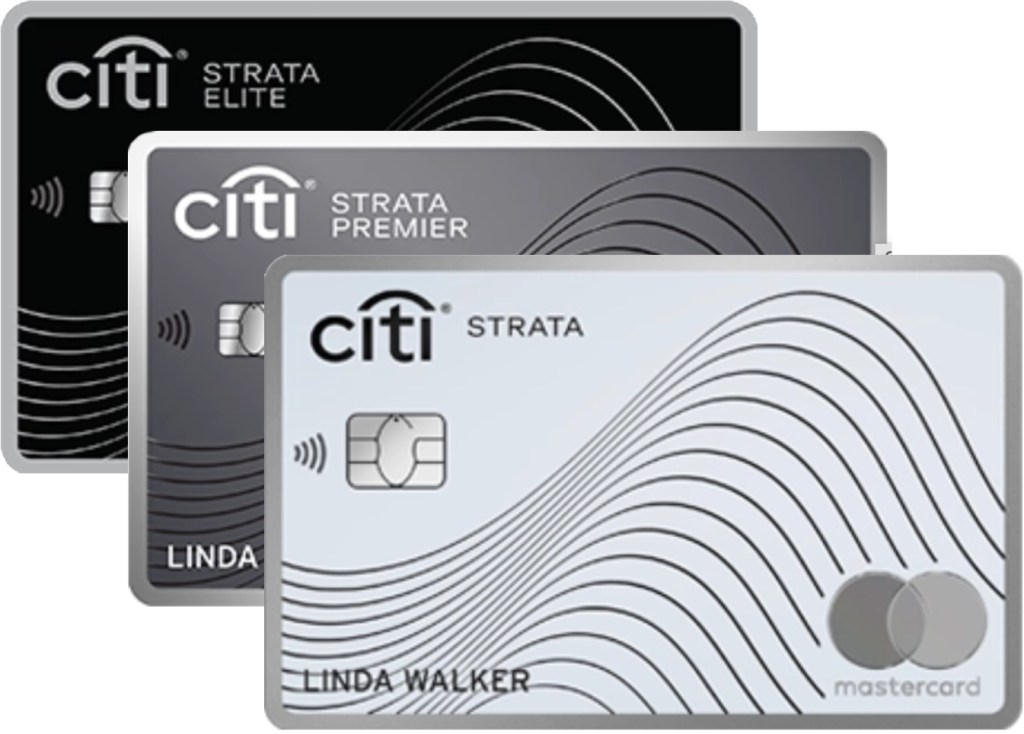
An introduction to the family
The Strata family is Citibank’s somewhat new family of credit cards. Only somewhat new, since the middle card (the Strata Premier) has been around for a while, and it’s only the no-annual-fee Strata and ‘premium’ Strata Elite that recently came out. We applied for this card soon after and even got an elevated in-branch-only welcome offer.
Of all of these cards, the Strata Premier is actually the most all-around useful, but its bonus categories are already well-represented by other cards we have. The Strata Elite’s bonus categories, meanwhile, may not be super useful to everybody but I do really like it perks. Indeed, the title says it all: this is not a card I put a lot of spending on, but rather I use it because I value the ongoing perks in combination with credits that are easy to maximize, so that I’m happy to hold on to it in the long-term. Let alone that in your first term you can ‘double dip’ on the value of the perks if you’re strategic with when you open the card.
Basic details (Strata Elite)
- Current welcome bonus: 100,000 points when spending $6000 in the first 3 months of card ownership
- Annual fee: $595
- Bonus categories:
- 12x on hotels, car rentals and attractions booked through Citi Travel.
- 6x on flights booked through Citi Travel.
- 6x on dining between 6pm and 6am the next day, on Friday and Saturday (‘CitiNights’)
- 3x on dining at all other days and times
- 1.5x on everything else
- Other perks:
- $300 annual hotel credit for hotels booked through Citi Travel (minimum 2-night stay).
- $200 annual ‘splurge’ credit, valid for use with BestBuy, American Airlines, LiveNation.
- $200 annual Blacklane credit (2x $100 every half year)
- $120 TSA PreCheck/Global Entry credit
- Priority Pass Select membership
- 4 annual American Admirals Club day passes
- Not a perk but something to be aware of: Citi ThankYou is the only points currency that has American AAdvantage as a transfer partner, which has some lucrative redemption opportunities!
What I use this card for
This card fulfills a different function to some of the other cards in this list, namely that I don’t really have this card for ‘spending’ money on, so to speak. The reason is that the bonus categories aren’t particularly attractive.
Long story short, I only use this card consistently for dinners out on Friday and Saturday night, when the card generates 6x points on such purchases. At all other times, the Amex Gold card is better, at 4x points per dollar. Otherwise, the primary motivation to have this card is for the Priority Pass membership, and the Admirals Club day passes.
Why I like this card
Despite the limited use to put spending on this card for us, I do really like this card. It’s a pretty good value proposition for the annual fee, despite the fact that on the surface it’s an expensive card. However, it’s easy to get that money back:
- The $300 hotel credit is basically a $300 discount on hotels stays booked through Citi Travel.
- The $200 Splurge credit effectively provides a $200 discount on flights with American Airlines
- The $200 Blacklane credit may or may not be useful to you, but I think it can represent a useful discount for airport rides. For example, a ride from Newark EWR to our home clocks in at $150, so with the $100 credit the ride will be cheaper than either cab or Uber, plus we get a professional chauffeur and a nice card. So, I can see us use this credit.
With those credits, we will already get the full annual fee out of this card, but its arguably the other perks that I’m personally most excited about:
- The 4 Admirals Club passes provide easy lounge access that no other card (save for Citibank’s co-branded AAdvantage cards) provide.
- The Priority Pass membership is valuable to us since we don’t have another card that provides it currently.
- Citi ThankYou is the only points currency that has American AAdvantage as a transfer partner. AAdvantage has some very good redemption opportunities on oneworld airlines, such as Qatar Airways and Japan Airlines. That is to say, they can be hard to redeem, but it’s consistently the cheapest way to get these flights.
Plus, there is a bit of secret to this card! Most of the perks are provided per calendar year. That means that if you strategically open this card (e.g. around September/October), you can use all your credits, and then in January you will get them again, meaning you effectively got the credits twice for the price of one membership year.
What’s not to love?
Favorite travel card: Chase Sapphire Preferred

Apply for the Chase Sapphire family (Preferred or Reserve) here!
An introduction to the family
The Chase Sapphire family may be one of the most popular family of premium credit cards around. There are two cards in this family: the Preferred and the Reserve. The Reserve used to be my favorite, but a recent revamp elevated the annual fee to $795 and added a slew of credits that I honestly find hard to maximize. If you (1) don’t travel all the time to use the lounge access perks, (2) don’t live around airports where these lounges are available, or (3) are not able to splurge on upscale hotels and restaurants, I can’t in good conscience recommend this card. Because ultimately, a lot of the credits of the Sapphire Reserve rwequire you to spend more to get back anything. Realistically, a lot of people don’t have that financial capacity.
And so, since that revamp, my favorite credit card in this fmaily is not the Chase Sapphire Preferred, for travel purchases.
Basic details (Sapphire Preferred)
- Current welcome bonus: 75,000 points when spending $5000 in the first 3 months of card ownership (normally 60.000 when spending $4000)
- Annual fee: $95
- Bonus categories:
- 5x points on travel booked through Chase Travel portal
- 3x points on dining
- 3x points on online grocery purchases (excluding Target, Walmart and wholesale clubs)
- 3x points on select streaming services
- 2x points on all other travel purchases (not through Chase Travel Portal)
- 1x points on everything else
- Other perks:
- $50 annual hotel credit through Chase Travel Portal.
- Points Boost: If redeeming through Chase travel Portal, your points could be worth up to 1.5 cents per point for certain selected travel purchases.
- Doordash DashPash premium (at least 12 months)
- 10% anniversary bonus: get a 10% bonus of the previous cardmember year’s spending in bonus points, at 1 point per dollar spent.
- Various travel insurances, including rental car damage waiver, baggage delay, trip cancelation and interruption and trip delay insurances.
- No foreign transaction fees.
What I use this card for
I use this card essentially for all travel purchases, in large part because of the insurances that the card offers, and that also includes local transit such as the subway and bus.
Why I like this card
I don’t actually like this card as much as I used to, since the vast majority of my spending now goes to the Amex Gold. However, for a card that’s only $95 per year, I do find it easy to justify holding onto it for the travel insurances that it offers. It’s because of that that I like to use this card for travel purchases, even if other cards give a better return on spending (such as Amex Gold’s 3x points for flight purchases). The hotel credit is nice however, and keep in mind that if you’re okay booking through the Chase Travel Portal, you could get 5x points per dollar. However, I tend to not go that route: flights are always best purchased through the airline to avoid finger pointing if something goes wrong, and hotels do tend to be a little cheaper in my experience through Expedia.
Ready to apply for this card? Apply for the Chase Sapphire family (Preferred or Reserve) here!
Favorite for miscelaneous purchases: Capital One Venture Rewards

Apply for the Capital One Venture here!
An introduction
Like the Sapphire, the Venture cards are also part of a family, with four members. However, the ones most popular are the Venture Rewards and Venture X Rewards cards, of which I have the ‘normal’ Venture card. However, the truth is that I may upgrade this card in the future.
Like with the Sapphire, the Venture and Venture X differ in their annual fees, with the X being the more premium and more expensive, with a $395 annual fee. The Venture is $95. However, the truth is that the cards are generally very similar, with mostly the same bonus categories, and this is one of the reasons I opted for the cheaper Venture card. the Venture X card does get a $300 travel credit to be use in the Capital One travel portal, and 10,000 bonus points every card membership anniversary. As such, the Venture X kind of ‘pays for itself’, and so it can make a lot of sense to simply opt for the Venture X. However, I do not like that the travel credit has to be spent at the Capital One travel portal – this is the second reason I opted for the cheaper Venture card.
Basic details
- Current welcome bonus: 75,000 points when spending $4000 in the first 6 months of card ownership
- Annual fee: $95
- Bonus categories:
- 2x on everything
- 5x points when booking travel through the Capital One Travel portal.
- Other perks:
- TSAPreCheck and Global Entry fee credit.
- No foreign transaction fees.
- Hertz Five Star Status
What I use this card for
The Venture cards have a flat 2x points on everything. This makes it a very easy card to use, because you don’t need to think about what your bonus categories are. That said, there are some categories where I don’t want to use it, because I get better bonus categories on other cards. As such, dining (Amex Gold), groceries (Amex Gold), travel (Sapphire Reserve) and some other miscellaneous categories are squarely NOT on Venture, but everything else is – and the truth is that that represents a lot of purchases! For example, most online purchases, including Amazon, I will use Capital One Venture for.
Why I like this card
I like this card for its sheer flexibility. There are essentially no cards out there that have bonus categories so lucrative that they cover every single pat of my ‘spending life’. So, necessarily, I have multiple cards that together aim to provide me with the best return on spending. However, there are cases where the categories just consistently don’t lineup, and the only way to get that bonus category is by getting a store card, which I’m not interested in due to the assigned dollar value your points typically get with such cards. This situation typically comes up with large retailers such as Macy’s or online shopping merchants such as Amazon. That’s where the Venture family comes in: because of the industry-leading 2x points, it is the best way to get rewarded for non-category purchases, such as at Amazon.
What makes the Venture X even more lucrative than the Venture is the fact that, on balance, the card is basically free: as mentioned above, the $300 travel credit (But note: at Capital One portal only) and 10,000 anniversary bonus completely offset the $395 annual fee.
Ready to apply for this card? Apply for the Capital One Venture here!
Favorite no-annual fee card: Chase Freedom Ultimate

Apply for the Chase Freedom Unlimited here! (Note an error may pop up that the offer may not be available – in fact it increased since the link was created!)
An introduction
Another popular family of cards from Chase is the family of ‘freedom’ branded cards. There are two of them, the other one being the Freedom Flex, and they are generally quite similar. Both cards are without an annual membership fee, so it’s free to hold on to. This is nice, because you don’t need to ‘justify’ holding onto this card. You can keep it without using it, and not ‘lose money’ on it.
In terms of the biggest differences, it comes down to the bonus categories. While both cards get 3x points at drug stores and dining, the Flex gets you 5x on rotating categories and 1x on all else, and the Ultimate ‘just’ gets you 1.5x on everything else. As such, the Flex can get you outsized value as long as you peruse the categories in the rotating categories (which can be groceries, gas, etc). If you don’t use these categories, a flat 1.5x can end up being more lucrative.
Basic details
- Current welcome bonus: $250 when spending $500 in the first 3 months of card ownership
- Annual fee: $0
- Bonus categories:
- 3% cash back on dining
- 3% cash back at drug stores
- 5% cash back on travel through Chase Travel portal
- 1.5% on everything else
What I use this card for
I currently use this card for just one thing: drug store purchases. It is the only card that I have that earns 3x points on this category, which typically includes merchants such as CVS, Wallgreens and Duane Reade. In the past I used this card much more widely, before I got the Venture card, since its flat 1.5x was still better than the 1x that I would otherwise get from other cards. Since I got the Venture, however, that 1.5x is not as lucrative anymore.
Why I like this card
The card is free, so holding onto it really is a no-brainer to me. At that point, this card mostly serves to extend my credit history, plus I get occasional use out of it when shopping at drug stores. But let me be clear: for anybody just starting out with credit cards, the freedom ultimate (or flex) can be incredibly rewarding ‘starter’ cards. Without an annual fee, some very useful bonus categories and an often generous welcome bonus (usually $200 back after spending $500 in 3 months), this card is kind of a no brainer. Truthfully, the card might not make as much sense if you have a sizable collection of cards, but if you find yourself in a situation where you may need or want to downgrade some existing Chase cards, downgrading them to the freedom family could make for a good strategy.
Ready to apply for this card? Apply for the Chase Freedom Unlimited here! (Note an error may pop up that the offer may not be available – in fact it increased since the link was created!)
Summary
In this post I discussed my current all-around favorite credit cards. I have discussed their basic details, what I use them for, and why I like them. I hope these insights have been useful and I hope they have given you some ideas for your own credit card strategy. In summary, here’s my current category breakdown, in simple terms:
- Dining purchases: Amex Gold (Citi Strata Elite on Friday and Saturday nights)
- Groceries purchases: Amex Gold
- Travel purchases: Chase Sapphire Preferred
- Drugstore purchases: Chase Freedom Ultimate
- All other purchases: Capital One Venture
But, if there is a key takeaway, is that you build your credit card portfolio around those categories that you spend the most money on, so you can earn their multiples in a rewards currency (I wouldn’t recommend cash back, typically). Use the three W’s: Why, What and When, in that order. The cards I have listed here go a long way to cover the major bonus categories and even leave some flexibility in the extent that you want to pay annual fees for them, with higher and lower priced credit cards, so they should work for many of you. Plus, they come with some nice perks to can really help to smoothen your (air) travel experiences with free lounge access and Global Entry/TSA PreCheck.
Do you have any other credit cards that you really like? let me know about them in the comments! Or would you like some help in deciding what credit card to get next? Reach out through the contact form and I’d be happy to help!
Disclaimer: the opinions expressed here are my own and are not sponsored by any bank or credit card issuer. My opinions should not be taken as financial advice, and you must take care to apply for credit cards within reason, and to use them responsibly, spending only within your means. Finally, I do receive a referral bonus from the bank or credit card issuer if you use the referral links I posted here, though these are not beyond what any other referrer would get. I’m not being specifically rewarded for recommending these cards over any others.


 Points to Seats
Leave a reply to Analysis: The Amex Gold card is a must-have for everybody that likes to eat – Points to Seats Cancel reply