
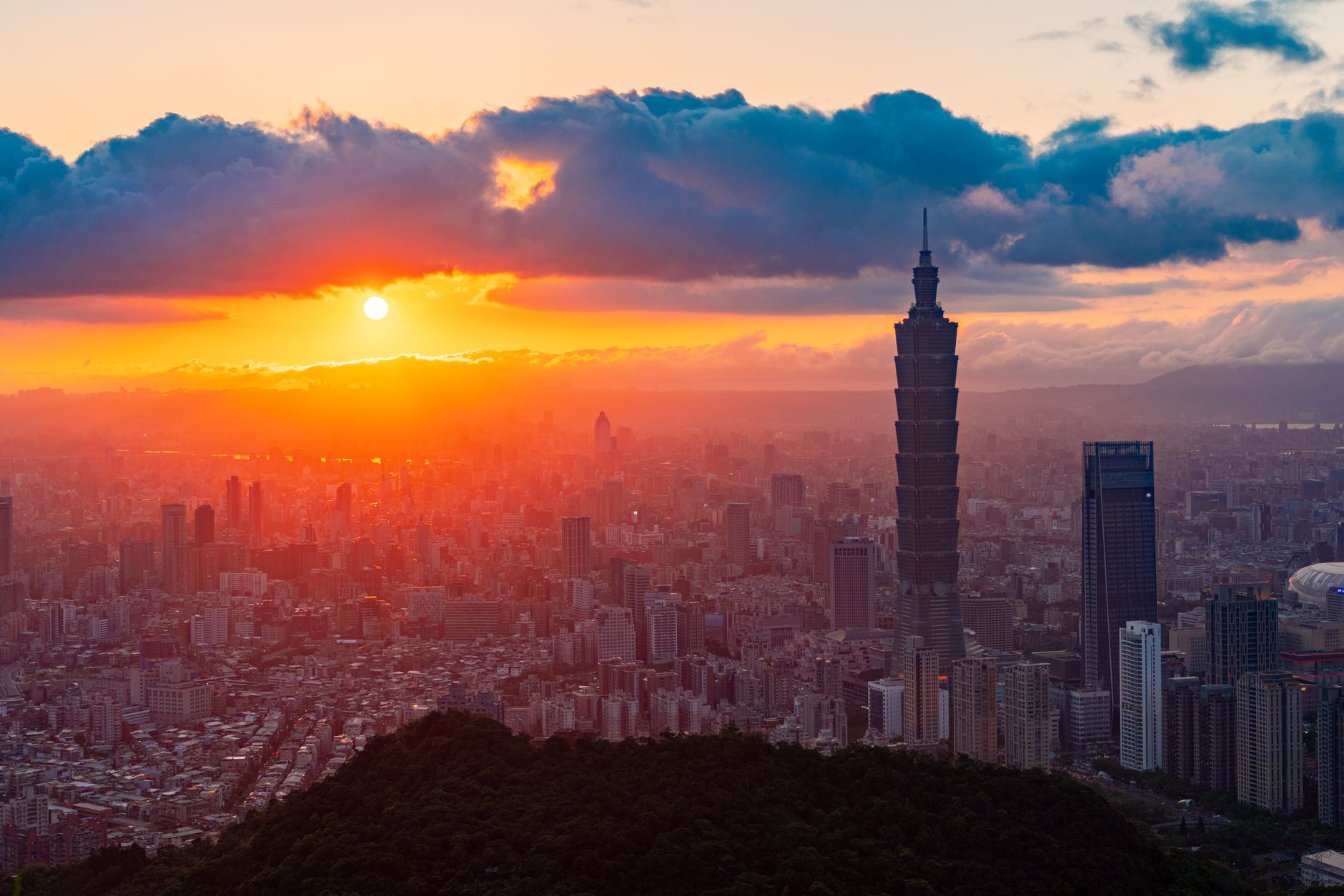
Ever since visiting Japan two years ago I’ve been intrigued by visiting Taiwan. I have many Taiwanese friends, but it’s actually not a place I hear much about otherwise. So I’m excited that I’ll finally have a chance to discover it all for myself in early 2027, as I just booked flights to Taipei! And I will accompanied on this trip with my mom, with whom I’ve started a tradition of sorts to do a trip or two together every year (we have visited Japan, Stockholm and Madrid so far). In this post I will outline my Taiwan itinerary, including where we will visit and the flights I booked.
Table of Contents
I’m going to Taiwan with my mom!
In 2024 I went to Japan with my mom. I’d wanted to visit Japan for a long time prior, and being able to bring my mom and explore together made for a lovely adventure together. Ever since, we’ve continued traveling together, including trips to Lyon, Stockholm, and most recently Madrid.
All this for two reasons: for one, I don’t necessarily always want to go back to the Netherlands to see her, given that I have limited vacation days to ‘spend’. Second, there are many places my mom would simply not visit by herself that I haven’t been to either. So, why not kill two birds with one stone and go to these new places together?
Since Japan I’d developed an interest in other East Asian countries, and soon that interest focused on Taiwan. Why? In part because I hear so little about the country, and that peaked my curiosity. Then, the occasional Instagram video showed beautiful landscapes, tasty-looking food and bustling cities. Finally, Taiwan is generally portrayed as an accessible country for foreigners, with good (and cheap) public transportation and a tourist-friendly population and facilities.
And so, I’m going with my mom to Taiwan! We are very excited and at this point have more or less finalized our itinerary, booked our hotels, and some car rental days for the parts of the trip that are outside of the cities.
Our Taiwan itinerary brings us up and down the island
So let me tell you a bit about our Taiwan itinerary. We will be in Taiwan for about a week, so that’s not very long. We have to be a bit picky with what we do and where we go, but talking with friends, colleagues and Google Gemini has lead us to the following itinerary, visiting Tainan, Sun Moon lake, Taichung and finally Taipei.

In terms of our flights, both my mother and I will fly into Taipei Taoyuan, Taipei’s major international gateway and home to all of the three major Taiwanese airlines. There is a second airport (Taipei Songshan), but it mostly serves a selection of East Asian international destinations.
Tainan: the old capital and dutch heritage
After we land in Taipei, we will immediately take a high speed train down to Tainan, the old capital of Taiwan. This is also where the Dutch, when they had a trading post in Taiwan, had setup shop. In the neighborhood known as Anping, there is still an old fortress, and in the city you’ll find the occasional Dutch-style townhouse (or so I’ve heard). I’m very interested to see these bits and pieces of Dutch history.

Tainan is otherwise well known for the food scene: it’s referred to as the food capital of Taiwan, with a number of local delicacies, such as the local version of beef broth with noodles. I’ve also heard that Tainan likes its food a tad sweeter (which I’m a fan of). I’m sure the night markets will be well-stocked with all of those dishes and much more, and of course we are eager to try all of it!

Sun Moon lake: natural beauty
We will stay in Tainan for only two nights, and at that point we are renting acar to drive over to Sun Moon Lake. Searching online for same of the natural beauty of Taiwan, Sun Moon Lake always comes up in the top three, together with Alishan forest and the northeastern coast of the island, and the cnayon that’s over there.
Sun Moon lake is Taiwan’s largest fresh water lake, surrounded by mountains, making for a beautiful view all around. There are two main towns where most visitors will be staying, and so are we. While biking is a common way to get around the lake at a leisurely pace, we will be using our rental car to tour the various sites. These include a temple, pagoda, and a gondola to get up to a vantage point and a historic park that details some of the ways that locals used to live back in the day.

However, the main purpose to be at Sun Moon Lake is to relax and soak in the natural beauty of Taiwan’s scenic central mountain range.
Taipei via Taichung: big city energy
After being at Sun Moon lake for two nights, we will depart somewhat early in the morning and drive to Taichung. This is the origin of Taiwan’s famous bubble tea, and we intend to visit some of the sites, including the original bubble tea shop. However, Taichung has a much longer history with tea, and there are several beautifully preserved tea houses in Japanese style.

We will only be in Taichung for an afternoon before taking the high speed train back to Taipei, where we will be staying the rest of the time we have in Taiwan. We will be staying close to the bustling and food-centric Yongkang street, in the Da’an district. Known for tons of locally-focused and more authentic restaurants, this should be a great place to be.

But of course we be will exploring all of Taipei in the three days we are there! We will certainly be visiting the bigger monuments, including the Chiang Kai Shek Memorial Hall, Lungshan Temple and the surrounding neighborhood, Dihua street and ‘old Taipei’, and the National Palace Museum. And how can we stay in Taipei without going to some of the famous night markets? We fully intend to explore the night markets and food scenes of Tainan and Sun Moon Lake, some of the biggest and best-known ones are in Taipei.

But Taipei is not just the sites and food, it’s also the surroundings. We intend to do a day trip to see the Yehliu Geopark, known for its interesting rock formations. Not too far from there is the town of Jiufen, with beautiful, old-style wooden houses. This is likely going to be flooded with tourists, but so be it. After all, when’s the next time that we will be here?

And with that, our Taiwan itinerary will come to an end, Both my mom and I will fly out of Taipei back home – I will fly back to New York, while my mom flies back to the Netherlands, several hours apart from another.
I’ll be flying China Airlines Premium Economy
Points to Seats is all about aviation and using points to fly in premium cabins. So, how am I getting to Taiwan? You may be surprised that I’m not flying business class and I’m not using points (given that this is otherwise the focus of this blog).
I bought my flight with cash: I’m flying China Airlines Premium Economy, and paid a bit over $2000 for the return flight for the basic fare option. This is more or less the standard price for Premium Economy fares to East Asia. Back when I posted on the cheap premium economy fares on Singapore Airlines to Southeast Asia, I also made a note that those fares didn’t really work for East Asia, where $1900-2400 is more or less typical.

Taiwan has a somewhat special aviation scene in that it is a fairly small piece of land that nevertheless has three full-service airlines that all compete not just for transporting the Taiwanese people, but also for transporting connecting passengers. Taiwan’s best-regarded airline overall is certainly Star Alliance member EVA Airways, with SkyTeam member China Airlines (not to be confused with Air China) in second place. However, since a few years there’s a third player: Starlux has quickly become a favorite as well.
You may have already guessed it: I’m flying China Airlines primarily because they are a SkyTeam member. But what are those perks?
Flying Blue Gold benefits: free seat selection, lounge access at JFK and TPE
Since I have Gold status with Air France-KLM’s Flying Blue loyalty program, I get some nice perks when I fly on a SkyTeam airline, and China Airlines is no exception. This is because my Flying Blue Gold status maps to SkyTeam’s Elite Plus status, which is the top alliance-wide status at SkyTeam. With status, I can:
- Free seat selection: since I booked a basic fare, seat selection would otherwise have cost me $65 per leg, for a $130 total savings.
- Get 1 extra suitcase, though I will not make use of that for a 1-week trip given that China Airlines provides a very generous 2x 28kg suitcase allocation for premium economy passengers.
- Receive lounge access: China Airline currently operates out of New York-JFK’s Terminal 4, and if they haven’t moved to the new Terminal One yet by the time of my flight, that means I’ll be able to access either one of the two Delta Sky Clubs (neat Gate B31 or Gate A8). However, if China Airlines moved (which seems like a strong possibility), I will have access to at least a Plaza Premium Lounge, but hopefully a gigantic new Korean Air Lounge will have already opened. Then on the way back, I’ll be able to access the China Airlines lounges at Taipei Taoyuan Airport TPE.
- I receive XP and Flying Blue miles: I’m going for Flying Blue Platinum, so by flying China Airlines Premium Economy I can earn 48XP toward that goal, which requires 300XP.
China Airlines has fixed-shell premium economy seats
In terms of the onboard product, there’s plenty of reviews out there to give you a sense of what you can expect, as well as comparisons with EVA Airways and Starlux. without going into those comparison, here’s what I’ve gleaned from China Airlines onboard product.
My flight will be operated by a Boeing 777-300ER, which is unfortunate since the A350-900 has a more comfortable layout in essentially all classes. As you can see in the below seatmap, the Boeing 777 premium economy cabin is in a 2-4-2 layout. I have selected the window seat in the bulkhead row, which I believe should make for a comfortable ride overall.


The seat itself, aside from differences in seat width, should otherwise be the same. China Airlines is using the AIRgo FX fixed shell seats in their premium economy cabin, with a seat width of 19″, row pitch of 39″ and recline of 118 degrees (as compared to 17.3″, 31″ and 116 degrees in economy).
But, note that the A350 premium economy seats have a seat width of 20″ and a recline of 129 degrees and are in a 2-3-2! That’s a big difference in the level of comfort, so it’s unfortunate that China Airlines doesn’t fly its A350 to New York.


Fixed shell seats have as a benefit that the person in front will not recline into your space. However, the ‘price’ is that instead of the seat back moving back, the entire seat slides forward. As such, in the recline position you may end up with less leg room. In the picture above you can see what that forward-sliding looks like.
I have now flown on Scandinavian Airlines and KLM’s premium economy, which both feature a normal reclining chair, and thought it was very comfortable. I’ve also flown Singapore Airlines’ premium economy, which was a hybrid model: the seat slid forward a bit while also reclining backward a bit. Ultimately that may be the best of both worlds in that it reduces the discomfort for the person behind you while limiting the measure of leg room that’s ‘lost’. It’ll be interesting to compare that with the fixed shell seats that China Airlines uses.
A nice amenity kit and decent food
In premium economy it’s relatively standard to be provided an amenity kit with some basic items, such as lip balm, an eye mask and a comb or dental kit. There’s generally not much that’s special about the premium economy amenity kits, with the fancy collabs usually being for the business class amenity kit (such as Le Labo in Singapore Airlines or Dyptique in Qatar Airways).
So it’s nice to see that China Airlines has a brand-name collab in both premium cabins: amenity kits are provided in partnership with Mark Jacobs, best known for their hand bags. The premium economy version of the economy kit comes in two colors and is dubbed ‘The Flight case’, and looks like a small leather pouch with some basic items. However, all in all, this looks like a very nice and high-quality amenity kit, on a higher level than what I’ve otherwise received with Scandinavian Airlines, KLM or Singapore Airlines.

The collaborations go beyond the amenity kit and includes the food, though of course not with Mark Jacobs. It’s nice to see that for the meals, China Airlines is collaborating with various popular Taiwanese restaurants in rotating menus with new collaborations seemingly announced per year or season. Currently, China airlines has a collaboration with Taipei-based Da-Wan Yakiniku Dining Restaurant, for example. While by the time I’ll be flying that collab will have ended, I look forward to see what they may have at that time.


In the pictures, the food generally looks quite good, but that’s common, of course. The real test is in the images provided by reviewers. While those don’t look as neat and perfectly plated as those provided by the airline, it still looks like quite good.
I will add, though, that reviewers have not been all that excited about the actual atste and quality of China Airlines’ meals, with EVA Airways generally garnering more favorable reviews. Even so, I’m looking forward to trying it for myself!
Summary
I’m excited to go with my mom to Taiwan in Spring of 2027! We will be flying China Airlines to Taipei, after which we will go on a roundtrip that will have us visit Tainan, Sun Moon Lake, Taichung and back to Taipei. I’m looking forward to exploring the various cities with its pretty temples and restaurant-laden alleys and streets. And I’m definitely excited to try the Taiwanese food, both in ‘normal’ restaurants and the world-famous night markets in Tainan and Taipei.
With regards to the flight, the major reason for me to fly China Airlines stems from my Flying Blue status, which extend to all SkyTeam airlines and provides free seat selection and lounge access. Despite the fact that EVA Airways does tend to get overall better reviews, I’m nevertheless looking forward to see for myself how comfortable China Airlines’ premium economy product is, from the seats, to the food, and the amenity kit as well.

Leave a Reply