
As part of our South African Safari trip, we first spent a week in the amazing Kruger National Park, and then we spent a week touring the Garden Route, culminating in a few days in Cape Town. And with that, our trip came to an end, and it was time to fly back home, to New York.
We’d be flying back from Cape Town on Ethiopian Airlines’ Cloud9 business Class, but not before visiting the two lounges that our business class ticket gave us access to: Bidvest Premier Lounge 1, at Gate A3, and then the Bidvest Premier Lounge 2 near the B gates. I reviewed these two lounges previously.
Now then, it was time to start our flight back. We flew from Cape Town CPT to Addis Ababa ADD, where we’d have an overnight layover, and then the next morning we’d fly from Addis Ababa ADD to New York JFK with a stopover at Abidjan ABJ. In this post I’ll be reviewing the first kleg of this itinerary: the flight from Cape Town CPT to Addis Ababa ADD.
Specifically, I’ll be reviewing Ethiopian Airlines flight ET846 on May 29, departing 3:25PM from Cape Town CPT and scheduled to arrive in Addis Ababa ADD at 10:50PM.
Briefly, this flight was a pleasant surprise! I knew in advance we’d end up in seats with a 2-2-2 configuration, but frankly, the seat was more comfortable than I expected, both upright and in bed mode, and I even had a nice nap. However, the service was the true surprise, and was a highlight of the flight. Overall, Ethiopian Airlines has all the ingredients to become a world class airline if it makes the investment to elevate those ingredients to the next level. Read on for all the details!
Table of Contents
How I booked this flight
I booked the full itinerary from Cape Town to New York via Addis Ababa as one itinerary through United MileagePlus:
- Ethiopian Airlines flight ET846 on May 29, departing 3:25PM from Cape Town CPT and scheduled to arrive in Addis Ababa ADD at 10:50PM (reviewed in this post).
- Ethiopian Airlines flight ET512 on May 30, departing 9:00AM from Addis Ababa ADD and scheduled to arrive in New York JFK at 8:00PM, with a stopover in Abidjan ABJ (reviewed here).
I booked this itinerary for 88.000 points and $52.71 per person, for a total of 176.000 points and $105.42 for my husband and myself. I had 23.000 points already in my United MileagePlus account. I then transferred 153.000 points Chase Ultimate Rewards points to get exactly 176.000 points, and immediately booked the tickets.
Although United mileagePlus miles are definitely not some great source of value, they do provide a cost-effective way for flights to Africa. If you have a United MileagePlus credit card you’ll get 10% off the mileage cost, so you’ll only pay 80.000 miles per person, plus the taxes. And, if you also have United Premier Elite Status, you’ll get a further 5% discount, bringing the cost down to potentially to 74.800 miles and ~$50 in taxes, which is great value, given the distance and flight time covered.
Mind you, originally both legs were supposed to be operated by a Boeing 787. Ethiopian Airlines is however well-known for last-minute (and I truly mean last-minute) plane swaps, and indeed, on the day of our departure the Ethiopian Airlines app showed that an A359 would be operating it. Happy days!
Note that part of this itinerary included an extended layover in Addis Ababa, and in such a scenrario as Cloud9 business class passengers you get complimentary access to the Ethiopian Airlines Skylight Hotel. Read my review and guide of this experience here.
Checkin and Lounge Access
We arrived at Cape Town Intl Airport from the rental car return facility, which is a short walk away from the departures part of the terminal. Upon entry, you take an escalator to the top floor of the building, where there is one large checkin hall that caters to checkin for all airlines, regardless of whether its domestic or international. Ethiopian Airlines is all the way on the left, directed by the electronic screens. When we got there, checkin hadn’t started yet, as we were quite early for our flight.
We waited for about half an hour, and in that time the signgage on the screens above the counters changed to reflect the various classes of service that Ethiopian Airlines provides. The business class line, which is marketed as Cloud9 Business Class by Ethiopian Airlines, was the left-most line and was serviced by two dedicated counters.


Unfortunately the label printing machine didn’t work so our baggage tags had to be printed from an alternate computer, but otherwise checkin was essentially smooth and efficient. The agent asked us if we knew what lounge to go to and whether we needed directions, but I had already figured out we’d be eligible to go to the Bidvest Premier Lounges (Lounge 1 and Lounge 2).
We nearly forgot to ask about this: Given our extended layover in Addis Ababa, we are eligible to stay at the Ethiopian Airlines’ Skylight Layover Hotel. As a business class passenger (regardless of how it was booked) you get complimentary access, but you do need to get a voucher for each person in the party. This is generally provided at the point of origin upon checkin, but my understanding is that you cna also get it upon arrival in Addis Ababa.
Initially there was some confusion on where the vouchers were: they were not as the checkin counter and would be provided at the gate, but we insisted we could wait for somebody to bring them. Ultimately, one of the agents left and returned 10 miniuted later with the vouchers, and handed them to us. Perfect!
Security is right behind the checkin counters, but there is no priority lane for business class passengers. Fortunately it wasn’t very busy, and we were soon on the other side.


Then comes a fairly long walk through a generally empty corridor, which terminates at passport control, where we were stamped out of South Africa. The terminal beyond is exclusively for international departures.
Immediately after passport control, on the right, is the Bidvest Premier Lounge 1, the first of two lounges Ethiopian Airlines business class. I have previously reviewed this lounge, but briefly, it’s a small but pleasant space with a very nice selection of food.


My favorite of the two lounges in the second one, the Bidvest Premier Lounge 2 by the entrance to the B-gates. This lounge is quite a bit bigger than the first one, with (what I think is) a nicer design, plenty of seating, and more or less the same food. There’s also a shower suite, though less electrical outlets.


We stayed in the lounge until right around boarding time, at which point the info screens showed our flight as… ‘boarding closed’? Suffice it to say we got scared and ran to the gate. One thing that was cool to see was this TAAG Angola Boeing 787. One thing that’s fun when going to a different country (or continent, sometimes) is the different airlines you get to see there!

When we got to the gate, along with a bunch of other people that also got worried when they saw the ‘boarding closed’ announcement on the info screen, it turned out that the information system was confused since our flight would leave from the same gate as an earlier Ethiopian Airlines flight, which had just departed. As for our flight, the plane hadn’t even arrived yet…
Boarding Process
Our flight was departing from gate A5, which situated in a narrow corridor that’s just in front of, but separated from, the corridor that leads from security to passport control. It’s quite a difference from the spacious gate areas around the main concourse! The area of Gate A5 is unfortunately cramped, warm and rather noisy and uncomfortable once people start showing up for the flight in larger numbers.

It also didn’t help that the inbound plane was delayed. While our booking said we’d be departing at 3:25PM, our boarding passes indicated a 3:10PM departure time, with a 2:10PM boarding time. Neither time ended up materializing, since our plane touched down around 2:35PM. The views from the terminal are terrific, so I was able to snap a few pictures of our arriving plane:


We ended up starting boarding at 3:02PM, with Cloud9 passengers invited through a dedicated line at 3:08PM. Because of how cramped and noisy the gate A5 boarding area is, it’s not easy to hear the announcements, so keep an eye on the signage that the gate agents are positioning, so you know where to line up.


Down the jetway there was a bit of a wait before we could enter the plane, but soon we were in. We were welcomed by the friendly flight attendants at the door. We were boarding through the second set of doors, so from there we were directed to turn left into the business class cabin.
Cloud9 Business Class Seat
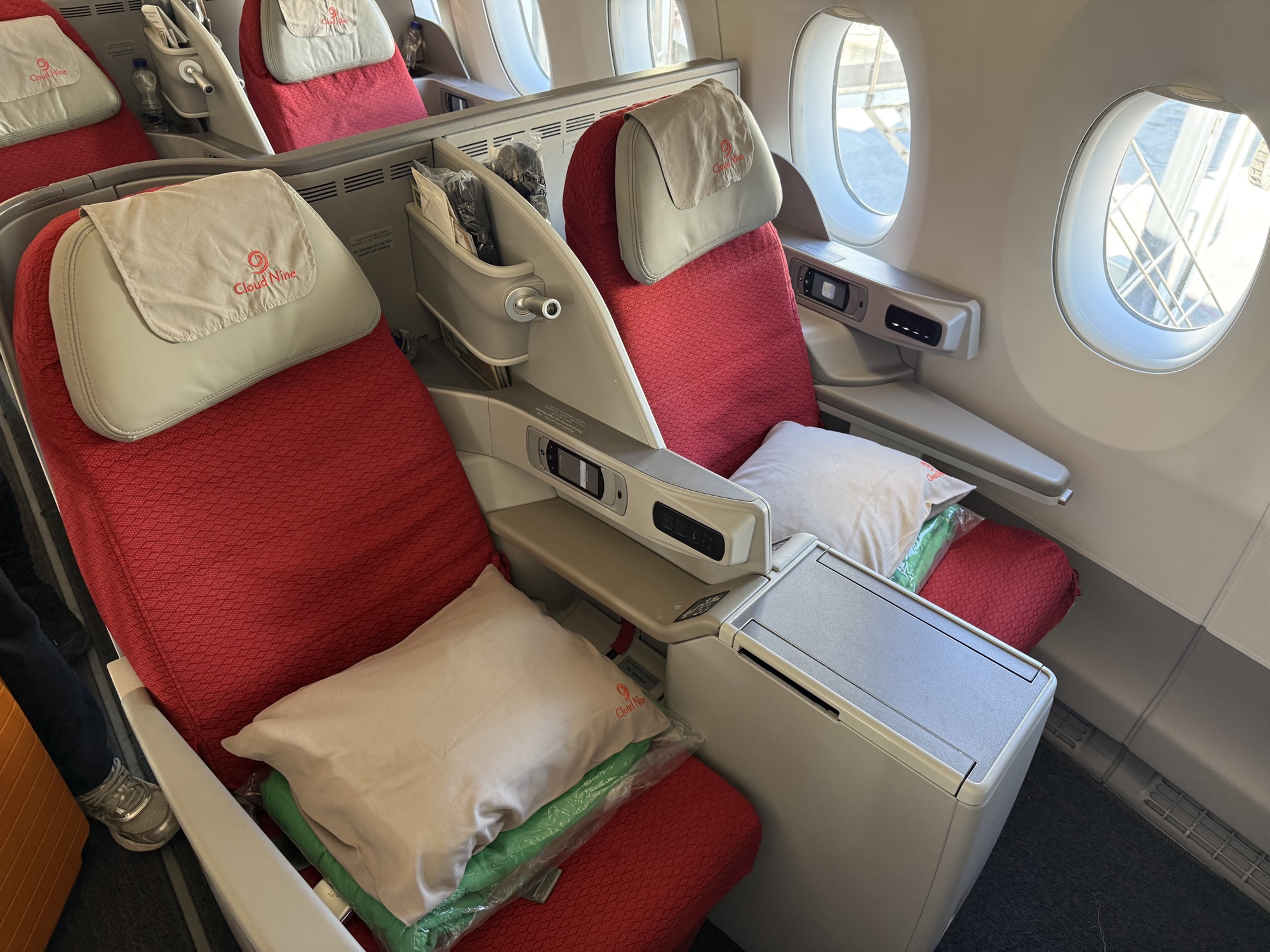
This Ethiopian Airlines A350-900′ Cloud9 business class cabin was equipped with the Collins Aerospace Diamond Parallel seating platform, which is in a 2-2-2 configuration with 5 rows total, all of them in between the first and second set of doors. Unfortunately, that’s Ethiopian’s worst (and also most prevalent) A350-900 business class seating platform, as the other two configurations are in a 1-2-1 configuration.
The downside of the 2-2-2 configuration is that the window seats don’t have direct aisle access, and there is less privacy and less storage at each seat. If you’re traveling solo, it may not be so nice to sit next to somebody else, but there is a small partition so that you don’t need to necessarily look at each other during the flight. But, since my husband and I were flying together, that wasn’t a problem at all.
While 2-2-2 is not particularly competitive compared to most business class products currently in service, in Africa many airlines have this in service. So, given the markets Ethiopian operates in and the lack of competition for airlines from other continents, 2-2-2 is a standard product. Do keep in mind that you may need to store more in the overhead bin, given that there;s not much in the way of storage in and around the seat.


The seats feature Ethiopian’s signature red, with the entertainment screen’s interface predominantly using green and yellow hues. Together these colors make Ethiopian’s (and Ethiopia’s) tricolor flag.
I had picked seat 2A for myself, and seat 2C for my husband. which is the pair of the seats in the second row on the left side of the plane, with 2A being the window seat and 2C the aisle seat.


The seat doesn’t look particularly spacious, and of course it won’t be as spacious as a seat in a 1-2-1 configuration, but sitting down it was cozier than I expected it to be. I thought the padding was good and made for a soft seating surface. The screen was a fair distance away, and felt more spacious then some other business class seats I’d flown. Of course, it’s more narrow than your average reverse herringbone seat, but I didn’t find that as disturbing as I thought it would be.
You’ll notice that there is a little coat hook to the left of the screen. I initially hung my coat there, but the flight attendant soon asked if I wanted her to hang it in the wardrobe, which I gladly accepted.


Looking down in front, the footwell looks a little bit tight, though I appreciate there is a bit of storage below the ottoman. This would be a good space to put a small bag that you’d like to keep in reach. Immediately beside the ottoman is the shell of the window seat in front, and at its base is a compartment for shoe storage. I love this: there’s few business class seats that have this, which results in them just lingering around. I highly appreciate a distinct storage compartment for them!


Storage is rather minimal with these seats. The biggest of the two storage areas is behin the seat and to the left. A bottle of water was there upon boarding. There’s a bit more space for any personal items you may have, or to temporarily keep a pillow or blanket. forward of that compartment you’ll also find the remote control, which can be popped out, as well as a USB-A port and a headphone plug.


The armrest to the left was in the raised position when I got to the seat, but it can be lowered as well to create a larger sleeping surface.


Then on the right and behind there is another storage compartment, primarily for literature. This is also where the headphones were, and there is a reading light as well.


Between the two seats is a console and arm rests. Leading up to the concole is a panel with seat controls, which feature presets for fully upright and fully flat, as wella s buttons to individually control the leg rest and back rest. Just aft of that is the life vest, in its own compartment.


At the front of the console are two universal power plugs, one for each passenger. The placement is a little awkward to get to, and requires your device to be on the console during charging.


You probably noticed that on each side of the console is something of a cutout. This is the tray table: you pull it upward and can then fold it out down. It’s a very sturdy table, and a little heavy. Expect not to be able to move out of your seat when it’s folded down.


Finally, the overhead console is the standard A350 one, with two reading lights and digital ‘no smoking’ and ‘fasten seatbelt’ signs. Unfortunately Ethiopian Airlines doesn’t have individual air vents.

Overall, Ethiopian’s most prevalent seat on the A350-900 is quite a bit better than I expected it to be. The 2-2-2 configuration certainly comes with a swath of downsides and there’s no denying 2-2-2 is not a competitive configuration these days (though in Africa, it’s failry common).
That said, I did find that the seat was very comfortable to sit in. The padding was good and comfortable to sit on for the duration of the flight, the placement of plugs and ports was fairly sensible and the tray table was sturdy. I wouldn’t be averse to flying this seat again, but if I can fly a seat in a 1-2-1 configuration, I’d choose it over this one, just because of the extra space and privacy.
Cloud9 Business Class Amenities
Waiting at our seat were several amenities. Tucked into the literature pocket behind and to the left of the back rest were noise canceling headphones. These were all right. I didn’t find them to be particularly comfortable unfortunately, but the sound was fine.


Also waiting at the seat were a pillow and a blanket. The pillow was a pretty standard one for business class, and was clearly more substantial than in other classes of service. The blanket, in ethiopian’s eye-popping signature green, was quite thick and pleasant to the touch.


As boarding continued, the flight attendant came by and handed out amenity kits. These come in multiple colors, and what you get depends on the color loaded onto the plane. On the flight the amenity kits were in a grey pouch. The pouch, as well as all the contents, are Ethiopian branded, so it’s not a fancy collab such as some airlines like to, including Qatar Airways (with Dyptique) or Air France (with Clarins skincare products).


For such a skinny pouch, this kit is nicely stocked with a bunch of typical but useful products. These include a comb, a dental kit, socks, a pen, lip balm, ear plugs and eye mask. The socks and skin mask are a pleasant quality.

Finally, the flight attendant passed by to provide us with slippers. I actually love these! First of all, they are the right size for my feet, and also they are quite well-made, with an actual rubber sole. Their quality is perhaps a bit better than those provided in Singapore Airlines business class, and definitely way better than those small, flimsy slippers provided by many airlines, including Japan Airlines and Air France.


Overall, Ethiopian’s amenities are what you’d typically expect in business class, but I did feel that some of the products, such as the slippers and blanket, are a little above average. Most other amenities, such as the amenity kit and pillow, were on par with others, though I appreciated the practical utility of the amenity kit’s inclusions.
Departure from Cape Town CPT
After receiving all the amenities, we were presented a warm towel. By now all business class passengers were in their seat, and the flight attendant came by to provide a welcome drink. On this flight there was a choice between various juices, water and champagne, and I had a glass of champagne, served in a glass with Ethiopian branding (though the letters had mostly faded). To my surprise, the champagne was poured at my seat, which I thought was a lovely touch.
Ethiopian currently serves Pommery Brut Apanage for the Champagne, which retails for about $60 and I thought was quite tasty.


We were of course delayed due to the late arrival of the plane, but by 3:35PM the purser came on the PA to welcome the passengers for the 5:45 hour flight to Addis Ababa, and finally by 3:39PM we started our pushback. At this point we had been provided menus, so we could take a look at the meal we’d like to have once in the air.


As we started our taxi to the runway, the safety video was screened, which I can only describe as ‘wonderfully retro’. It kind of looks like something from the late nineties.


It took only about 5 minutes to get to the runway. Once we turned onto it, the engines spooled up almost immediately and we started on our takeoff roll. Soon we were in the air and bidding Cape Town farewell.


The weather was fantastic on the way up, allowing for some beautiful views of the coastline, with cape Town’s stunning mountains in the distance.


Main Meal Service
After about 7 minutes the seatbelt signs were turned off and the flight attendants spring up to start service, starting by closing the curtains between the cabin and the galley. The first offer came on the PA to welcome the passengers, providing some details on the flight.
Since menus had been distributed on the ground, I had a moment to look at the meals available. We had actually pre-ordered meals through the Ethiopian Airlines website, but it doesn’t seem any of that was actually recorded, so the flight attendants took our orders as if we had not put any pre-ordered in. I did ask about this, but was met with a surprised stare and an apology, that she was not aware of this. Ultimately it’s not a problem at all, though I wodner why pre-orders are offered if they aren’t acted upon?
The menu can be seen below. As you can see, the menu is for the full return journey, regardless of what leg you’re on. While we were flying CPT-ADD, the menu also listed ADD-CPT, and it was interetsing to look at the differences. As you can see, both flights have only one meal service, but the one ex-ADD is more substantial, with an Ethiopian dish course as well.


The menu also lists the full drink selection, including the champagne on offer, as well as the sparkling, rose, white and red wines.


Meal orders were taken around 4:09PM for the main dish and an accompanying drink, and I ordered the pan seared filet mignon. For the drink, I asked if there were any Ethiopian wines and was suggested with the Rift Valley red, so I picked that. The meals service would start about half an hour later, at 4:45PM. In the interim I started watching a movie and I messed around with the WiFi, which I couldn’t get to work. More on that later.
Service started with the flight attendant assisting with the tray table. Serving our aisle was the lovely purser, Sosina, was was soft-spoken, gentle, very friendly and professional. She then lay down a white table cloth. I was curious of my orders would be provided as requested.

To my surprise, at Ethiopian all dishes are placed directly on the tray table. Initially, the utensils, a glass, salt and pepper shakers, olive oil and butter were placed down, and then the food was served. For the starter, there was a quinoa salad with chicken terrine, a side salad and white bun.
Indeed, the Ethiopian Rift Valley red turned up as well, but rather than just providing me a glass, I was first poured a little bit, so I could try it, and then when I confirmed that I liked it, I was presented with a full glass. What a lovely way to provide the service!


So, the food doesn’t look all that great, but the taste was fine. I wouldn’t say it was something terrific, but it also wasn’t bad. The wine, on the other hand, was quite nice. I never knew Ethiopia had its own wine industry and I was glad to try some.
The table was cleared around 5:19pm, and then the main dish arrived at 5:29pm. The main dishes were brought out per passenger, rather than on a tray, which is another ncie touch in the service flow. This makes it feel more personalized rather than brining everything off a cart, since it’s down at the pace at which passengers eat.
I had ordered the filet mignon, which came with ratatouille and potatoes. I do believe these are plated on the plane, given how nicely centered the food is, with the plate being nice and clean otherwise (though I could be wrong). The vegetables were really nice and flavorful, and I also enjoyed the potatoes. The filet mignon was also better than I expected, even if it was a bit dry.


I finished this around 5:36pm (I guess I eat fast). At this point the table was mostly cleared, save for the drinks. Then the dessert cart came out some 20 minutes later, allowing passengers to pick and choose what they want. On offer were a vanilla tartlet, whole pieces of fruit, or a selection of cheeses, as well as various dessert wines, and I went for the vanilla tart and a kiwi.


The tartlet was tasty, but I don’t particularly the concept of handing out whole piece of fruit. Ona. plane, without proper utensils in a position that’s not necessarily all that practical, this seems like a strange choice. I like kiwi, but picking it on a plane and then peeling it, with the juicy mess that it entailed, was honestly not a great idea. Really, I think Ethiopian should switch to cut fruit, as so many other airlines already do!
To conclude the meal, I was offered tea or coffee, and picked a ginger tea, which was nice and was served with a chcocolate. The brand seemed to be an Ethiopian one.


Around 6:23pm I had finished my tea and such, but it tooka. while for a flight attendant to actually clear the table, so I flagged one down and asked her to remove everyhting, which she promptly did.
Right around that time, Africa gave us one of it signature sunsets, for a gorgeous evening display. Africa truly has some of the most beautiful sunsets I have seen!


With that, the main meal service concluded. It’s interetsing: the food itself is just fine, and honestly nothing special. I’ve had better food at other airlines, and also worse food, though with the various experiences I’ve had so far, I’d have to rank the food quality at Ethiopian cleaer to the bottom of my exeperienmces so far.
However, what impressed me was the restaurant-style experience. I had no particular expectation for the service, but I genuinely feel Ethiopian comes out very favorably when compared to many other airlines. It’s a remarkably customized, restaurant-style experience, that I honestly think is not so dissimilar from Qatar Airway’s meal service flow. With dishes placed directly on the table (no tray), providing earthenware salt and pepper shakers, brining dishes out at the pace at which passengers finish food, and the way in which I was asked to try the wine before pouring a glass. Very nicely done, Ethiopian Airlines!
Entertainment System and WiFi
Ethiopian Airlines offers a fairly modern entertainment system and WiFi on their A350. At 17″, the screens are a good size, but that’s also because they are a bit further away from you than in your typical reverse herringbone seat. There is remote control in the armrest behind and to the left of the seat, and this may be useful in some cases, for example when you’re eating and the tray table is blocking you from leaning forward.
But otherwise, the screen is a touch screen so you may not need to use the remote at all. The screen quality was quite good, with crisp colors and resolution.


After selecting a language and seeing an introductory video to Ethiopian, you’ll be presented with the main menu. The home screen lists a variety of entertainment options and featured content. You can scroll down or up to reveal more featured content.


On the right you’ll see three icon. While the logo of Ethiopian doesn’t actually do much, the magnifying glass brings up a search bar. There are a few categories to narrow down the search results a bit.

Finally, the gear icon brings up the settings pane, allowing control of a variety of entertainment system and seat functions. That includes volume and screen brightness, but also control of the reading light or calling the flight attendant.

On the left is a series of icons that allow quick access to the various types of content, such as movies, TV shows and music. If you click those icons, a list with genres will be present in yellow lettering. As you can see, the list of options is substantial. However, I do feel as though the selection is not quite cutting edge. There are many movies to choose from, but a large number of them are older, and there aren’t quite as many new releases as on some other airlines.


The last two content types including information on Ethiopian and the flight, and this also includes the moving map. The final category allows some personalization features, such as the creation of movie and music playlists. Personally I never use these and I’m never sure if anybody else does?


A funny feature of the moving map is that it initially opens up in a little popup window in the lower right of the screen. You can then click it again to make it fill up your screen.


Ethiopian also offers Viasat WiFi, which tends to be one of the faster WiFi options airlines can install (after Starlink, of course). Unfortunately, getting onto the WiFi was not so easy.
You initially connect to the onboard WiFi network, called ETInternet. Once connected a window opens up, which is where you’re supposed to enter any sort of WiFi pass, make selections, pay, etc, except that this didn’t work so smoothly. Fortunately there are some instructions on where to go if the page doesn’t load:


Truthfully, initially I clicked that screen away without propeprly making note of the URL that was presented, and it took me some time to figure out where to go. When I finally realized I had to go to https://ethiopianwifi.viasat.com, I was finally able to see all the options, as shown below.
The welcome screen shows you the progress of the flight, as well as a few buttons to click to show further information on the flight. If you click the WiFi icon that says ‘connect;’, at the bottom, you’ll go to a page with a price list. Prices range from $5 for 1 hour to $25 for a full plan, so I think these prices are very reasonable. Just keep in mind that WiFi connectivity over Africa can be very fragmented, so you may not actually have much WiFi at all.


As a business class passenger, I was provided a promo code on a little card, which was handed out a little while after takeoff.

If you click the ‘redeem’ option for the promo code on the ‘Connect’ page, you will be asked to enter your email and the voucher code. By linking the code the voucher, you should be able to switch the WiFi between devices, so it functions as something of a username.
I filled out my details, clicked ‘redeem’, and was brought to a confirmation screen that showed that my WiFi plan was activated. Once online, I was pleasantly surprised by the WiFi speeds. It was possible to browse and look at some websites with images loading reasonably quickly.


All in all, Ethiopian’s entertainment and WiFi are solid, but not cutting edge. There should be plenty of options to choose from, and I for one had a nice time watching a few older movies that I hand’t been able to see yet. The WiFi was a bit of a pain initially to get setup, as I was snot able to enter the welcome page. Once I did get connected, the experience was pretty good, so I imagine that if you’d want to do some actual work, this WiFi would suffice.
Lavatories
After dinner I stepped to the lavatories. Ethiopian Airlines’ A350 has four lavatories around the business class cabin, with two in the front and two to the back, though the latter two may be used by economy passengers as well, I believe. Since I was in seat 2A, I always went to the forward one, given that it was closer by.
Ethiopian’s lavatories are quite barebones, actually. There’s some additional amenities, including some handsoap, cologne and wet towels, but not much else. There’s also no decoration of any kind, with the lavatory being the usual white and grey of an airplane lavatory.


However, I must commend the crew for the effort they were putting into keeping the lavatory clean. When I visited the lavatory at any point throughout the flight, the lavatory was kept clean and tidy. It even smelt fresh with a citrusy cleaning product, and I witness the flight attendant go in to clean up a bit every 2 hours or so. That’s a lot better than at most other airlines!
Fully flat: Lounging in Cloud9 Business Class
After coming back to my seat I started watching Beetlejuice Beetlejuice, which was surprisingly fun. But after about 38 minutes I started getting a little sleepy, so I reclined my seat and made my bed for a quick nap.


Overall, the seat is quite a bit more comfortable in bed mode than I thought. I didn’t have particularly high expectations, but I think padding helps a lot. Some business class seats these days are not particularly soft, but these seats were nice to sit in and also to lie down in. And despite the footwell looking rather tight, it was better than I expected. I had ample room for my feet and was even able to lie on my side without feeling uncomfortable or too restricted.

I rested my eyes around 6:50pm, and must have fallen asleep because when I opened them it was 8:10pm, with about 1.5 hours to go. Despite the fact it wasn’t a particularly long nap, I felt quite refreshed.
Arrival at Addis Ababa ADD
For the rest of the flight I continued watching Beetlejuice Beetlejuice, until around 9:10pm the first offer came onto the PA to announce we’d start our descent soon. We were flying over Southern Ethiopia at that time with about 25 minutes go when we started our descent at 9:15pm, and I switched to the moving map, seeing that the movie had ended.


A few minutes later the flight attendant returned my jacket in preparation for arrival, but then the weirdest thing happened: the flight attendant came over and without even asking or acknowledging me, she turned off my movie and opened an inflight survey. She just pointed at it and said ‘please fill out’. Given how lovely the service had been, this seem incredibly odd and unfriendly. I did fill out the survey quickly and then moved back to the moving map.
Since Addis Ababa’s Bole Intl Airport has been engulfed by the city, the approach brings you over the flickering lights of the city, making for a lovely approach. At 9:33pm flight attendants were instructed to land and we flew lower and lower, down to the runway.


We touched down at 9:40pm, which turned in 10:40pm since Ethiopia is in a different time zone than South Africa. We had a short taxi out of the runway and to the gate, though we had to wait for a departing 777 to be pushed back. We finally docked at ADD’s Terminal 2 at 10:53pm, and soon left the plane and got on our way to Ethiopian Airlines’ SkyLight Hotel, part of Ethiopian’s transit program that’s complimentary for Cloud9 business class passengers (see my guide here).


Ethiopian Airlines Cloud9 Service
I think Ethiopian does a surprising number of things right, or is at least in the right direction. But number one amongst those things is the service. I was really very pleasantly surprised with the service standard and the service flow during this flight.
In terms of the service standard, the service that team lead Sosina provided was always with a smile. She was friendly, professional, and happy to help. She was also quite careful gentle in her manner of serving, and while this may just be a personal trait of hers, it was my impression that the entire crew was doing a good jon. In all honesty, I was not expecting such a pleasant service style, and in terms of the crew providing pleasant, generous and well-intentioned service, I’d rank Ethiopian very highly.
The second component to the service experience is with regards to the flow. You can have well-intentioned crew that provide poor service simply because the way the airline structures the service doesn’t make much sense.
With Ethiopian, I was generally impressed by the flow. From the welcome aboard, to taking orders and the meal service, I really liked how the service was provided and items were presented. This was specifically obvious during the meals service, where a restaurant-style experience was executed better than on some other high-profile airlines. I was impressed that I was asked to taste the wine, and I liked how all dishes were placed directly on the tray table.
That said, two things bothered me: about halfway the flight, Ethiopian starts its dutyfree service. This is announced with a very long video that interupts whatever you’re doing, so you’re kind of forced to watch it. If it were quick that’d be okay, but this video stretches on for at least 5 minutes, making it quite jarring. Then the flight attendants pass through with the products, but frnakly it doens’t seem anybody is interested. I wish Ethiopian Airlines wouldn’t push this in your face the way they do.
The other thing that bothered me was the way in which I was kind of forces to do the inflight survey. The way an attendant simply interrupts what you’re doing by tapping your screen and starting the survey for you was rather rude, and I can’t comprehend how the service standard can drop so low after providing an otherwise lovely service throughout the flight.
All in all, I commend Ethiopian Airlines for providing lovely service throughout the flight. I actually think Ethiopian’s service is better than a swath of airlines around the world, and would be happy to fly with them again.
Summary
Overall, Ethiopian Airlines’ Cloud9 Business Class was a very pleasant surprise. It’s cklear to me that Ethiopian has all the ingredients to become a world class airline if it makes the necessary monetary investment to elevate those ingredients to the next level.
Based on the cabin, with its 2-2-2 configuration and somewhat outdated looks, Ethiopian Airlines provided a very nice flight experience. Despite the 2-2-2 conjuration, the seat itself is very comfortable both upright and in bed mode and if you’re flying with somebody, the 2-2-2 conjuration shouldn’t be too cumbersome. Its main drawback is a lack of storage in and around the seat, so you may need to store more in the overhead bin.
Highlight for me was the service, which was well-intentioned, friendly and surprisingly elevated compared to many other airlines. This was especially clear during the meal service. Although the food itself is just fine and really not particularly special, the service flow and features of the service are something to take note of. I liked how dishes were serve don the tray table and how I was given a chance to taste the wine before getting and full glass.
If anything, I’d consider Ethiopian Airlines to be a ‘poor man’s Qatar Airways’, and I truly mean that in the best way possible. The reason is that Ethiopian provides a lot of the same amenities, service flows and standard as Qatar Airways does; it just lacks a lot of the bells and whistles, and luxury feeling that Qatar Airways provides. However, Ethiopian delivers where it matters, and so if the airline were to invest in elevating its products (starting with throwing out the comfy but uncompetitive 2-2-2 seating configurations in its planes), Ethiopian Airlines may very well become a world class airline.
Prefer the visual version? I turned this review into an Instagram carousel — save it for later: Carousel Link
Prefer the visual version? I turned this guide into an Instagram carousel – save it for later and follow Points to Seats on Instagram to be alerted in the future.

Leave a Reply